
Sunday Reflections
12th Sunday in Ordinary Time – June 21, 2026
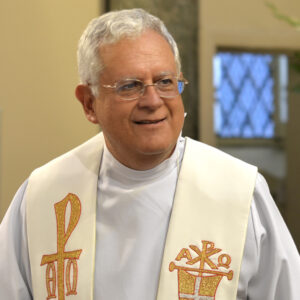
Reflection by:
Fr. Paul Voisin, CR
There is a famous British novel called Tom Brown’s School Days, which was also made into a movie. Tom Brown was a popular boy at a boarding school in England, and many of the boys in his class and dormitory took their cue from him. One day a new boy came to school, and that night, before getting into bed, the boy knelt down and prayed silently. Some of the boys snickered and others laughed and joked. One even threw a shoe at him. However the boy continued his prayer. Tom Brown had trouble getting to sleep that night, as he remembering when he would kneel down and pray, as his mother taught him, and now he was making fun of a boy who had the courage to do what he was taught. The next night, as the boys prepared to continue making fun of their new roommate, Tom Brown also got down on his knees with the new boy and prayed in silence. Not one boy snickered, laughed or joked, or threw the other shoe.*
I thought of this when I read the gospel of today (Matthew 10:26-33) when Jesus says, “Everyone who acknowledges me before others I will acknowledge before my heavenly Father. But whoever denies me before others, I will deny before my heavenly Father”. Jesus paid a price for sharing the Good News, eventually leading Him to death on the cross. He was scorned, laughed at, and driven out of some towns. On a few occasions people rose up against Him. However, he continued to do the will of the Father, and to proclaim the Good News. He told his disciples that they too would share this treatment, that they too would suffer for proclaiming the Good News and continuing His mission. Yet, the same gospel gives us hope and confidence because Jesus assures us that we are not alone, that God is with us, and He accompanies and protects us. We are of great value to Him, and we should not be afraid.
Our First Reading from the Book of the Prophet Jeremiah (20:10-13) reflects the plight of the prophets. Their ‘Good News’, given to them by God, was regarded as ‘bad news’ by the people, because it called them to repentance, to conversion, and to a change of life in order to be faithful to the covenant with God. Jeremiah is experiencing this reject from the people and knows that he is putting himself at risk. However, Jeremiah recognizes that “the Lord is with me, like a mighty champion: my persecutors will stumble, they will not triumph”. Jeremiah bravely fulfilled His mission with this confidence in God, and God’s protection.
In the Second Reading from St. Paul to the Romans (5:12-15) St. Paul reminds us that we share in the life of God, and he has given us His grace to live in union with Him.
As I reflected on the readings I began to ask myself, “How does one ‘acknowledge’ God in today’s world?” “How do we bear witness to Christ here and now?” “Would we have the courage of Tom Brown, and pray in public, and take the risk of being laughed at?” Many years ago the term ‘the anonymous Christian’ gained popularity, as many believers preferred to ‘blend into the background’ and not call attention to themselves by words, gestures or actions that proclaim that Jesus is their Lord and Saviour. Perhaps we have all struggled with this before other people. Today, with political correctness, we are so conscious of respecting the views and traditions of others, but often at the expense of our own views and traditions.
I can remember, as a child, making the Sign of the Cross each time we passed a Catholic Church on the street, and bowing one’s head at the name of Jesus. I can remember saying grace before a meal in a restaurant. We proudly participated in public expressions of faith such as processions, and in Hamilton (Ontario) Diocese the famous ‘Marian Day’ in Iver Wynn Stadium in Hamilton.
Once again, “How do we ‘acknowledge’ God in our time and place?” When I worked in Bermuda there were one hundred and twenty-six (at last count) Churches, so faith is not a secret there, and many denominations have public demonstrations of faith on occasions. However, in our personal lives it may be a struggle, and we may be riddled with fear about being ridiculed, or being questioned about things of the Catholic faith that we cannot answer. With the sexual abuse scandals involving the Church many Catholics have gone ‘underground’ and try not to say that they are a Catholic, or identify themselves with the Church. They would prefer to be an ‘anonymous Catholic Christian’. That does not reflect the spirit of our gospel, or the faith that animated giants like Jeremiah, the apostles, and the saints to witness to the life of God they shared in. I had the privilege on three occasions to visit the cell of St. Maximilian Kolbe in Auschwitz, a man whose defiance of the Nazi regime cost him his life. I am sure we will not be asked to go to that extreme to proclaim our faith in Jesus, and our allegiance to the Church.
In our families, at school, and at work, we are called to witness to Christ, not necessarily by our words – by ‘preaching’ to others – but by our actions and our way of being. St. Francis of Assisi said “Preach the Gospel at all times. Use words when necessary”. There are subtle and every day ways that we can “acknowledge” Christ. We should be the first to offer welcome and friendship to the newcomer, when others give a cold shoulder. We should be the first to forgive, when others seek revenge. We should be the first to encourage understanding, compassion, forgiveness and reconciliation, when others are ‘shutting down’. We should be the first to stand up to the bully, while others cower. We should be the first to interject hope into a conversation, while others are filled with doom and gloom. We should be the first to encourage someone to turn to prayer in their situation, when others have given up. We should be the first to model stewardship for others, when others are selfish and protective of their time, talents and treasure. We should be the first to give of ourselves in service of others, without counting the cost, while others seek reimbursement for every little thing. We should be the first to squash rumours and gossip, when others are ripping apart someone and ruining a reputation. We should be the first to encourage peace, when others foment discord.
These things are not impossible! I am sure we can all identify with them, and the experiences we have had when – perhaps even unconsciously – we have ‘acknowledged’ God, God’s grace, and His love and mercy. Jesus tells us today that our reward will be that He “acknowledges” us when we come before the Father.
*This introductory story is taken from Illustrated Sunday Homilies, Year A, Series II, by Mark Link, S.J. Tabor Publishing, Allen Texas. Page 75.
Share This Post
More To Explore

28th Sunday in Ordinary Time – October 11, 2026
So many come to Mass without their hearts being clothed with the right spirit, with the proper wedding garment…

27th Sunday in Ordinary Time – October 4, 2026
The readings about vineyards made me think about the work that the people of Tanzania put into planting their staple crop of corn…