
Sunday Reflections
15th Sunday in Ordinary Time – July 13, 2025
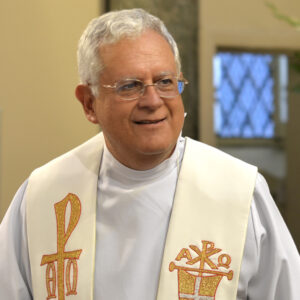
Reflection by:
Fr. Paul Voisin, CR
One time on a retreat I remember the Retreat Director asking us to reflect on how much we love God. He said that the majority of the people will think in terms of who is the most cherished person in their life – perhaps their spouse, a parent, a child, a close friend. We may give ourselves a pat on the back and congratulate ourselves for being such a fantastic person, and loving God even more than that deep human love. But he challenged us to think of the last person on our list, the person who we avoid, the person we want to have nothing to do with, and he said that this should be the measuring stick of how much we love God. After all, he told us that this person is also a child of God, and has their successes and failures, their joys and their sorrows. They are another person just like ourselves! Yet, for some reason – that we can explain or not – we do not love that person, we don’t even like them, or want to be around them. That is a sobering thought, especially when we consider that, without a doubt, we are each in the last place on someone else’s list.
I thought of this test of the quality of our love for God when I read over the gospel (Luke 10:25-37) for this weekend – the famous parable of the Good Samaritan. To appreciate this parable one needs to know that the Samaritans and the Jews were not friends. They were all Jews, but the Samaritans, caught in the middle of Palestine, did not regard Jerusalem as their Holy City, but rather worshipped God on Mount Gerisim. Both Jewish and Samaritan religious leaders taught that it was wrong to have any contact with the opposite group, and neither was to enter each other’s territories or even to speak to one another. Thus, the shock when Jesus spoke to the Samaritan woman at the well, and now using a Samaritan as the ‘good guy’ in a parable. So, what a shock for the listeners that day when in this parable it was a Samaritan who reached out and cared for the Jew who had been beaten and robbed. Both the priest and the Levite avoided the wounded man, because if they had touched someone who was bleeding they would be considered unclean, and would have to go through a ritual of cleansing before they could enter the synagogue or the temple. But it was the Samaritan – the last and least on the list of the Jews – who showed compassion and was the true ‘neighbour’ in the parable.
In our First Reading from the Book of Deuteronomy (30:10-14) God is very straight in revealing to the people through Moses that they are to be obedient to God, and follow His commandments of the Law. They are to “return to the Lord … with all their heart and all their soul”. Moses emphasizes that this is not “mysterious and remote” for them, difficult or impossible, but within their grasp because God is with them, and God wills it. He reminds them that it is already “in their hearts“, and “they have only to carry it out”. He makes it sound so simple, yet we know that in our human condition it is not easy to meet that challenge of God.
In the Second Reading from the Letter of St. Paul to the Colossians (1:15-20) St. Paul reminds the people that their true life is in Jesus as their Lord and Saviour, and that their lives are blessed through their life in Christ. His power is at work in them.
Although we all seek love, and want to be in loving relationships, it is not easy to love. Unfortunately, in our human condition, we have created barriers between ourselves and others. We have distanced ourselves from others. We may have even made propaganda against someone – a ‘former friend’ – because of an incident, or a rumour, or a perceived slight against us. Sometimes it can appear that there is ‘mine field’ in the realm of friendships. The parable of the Good Samaritan teaches us some important lessons about friendship.
First of all, that potential friends are everywhere. One of our priests in Canada had a sign on his door for years that read, ‘There are no strangers, only friends we have not met’. When we open ourselves to friendship we may find ourselves flooded with friends – and I do not mean ‘friends’ on facebook!
Second, we learn that sometimes we may be surprised who has the quality of a friend that we are looking for. We might be surprised whose paths we may cross – for the first time, or a number of times – and discover the qualities of that potential friend. Too often we can judge by appearances, or first impressions, and only when we get past that, do we discover just how great that other person is.
Third, a true friend – like the Samaritan – is willing to help us. The Samaritan bound the wounds of the man, put him on his beast of burden, cared for him, and then even left funds for his continued care. A sign of friendship is that one is a good steward of time, talents and treasure to invest in the friendship. A friend is not an observer, but a participant. A friend is a giver, not only a receiver. A true friend makes it clear, ‘It is NOT all about him or her”. A true friend may take the risk and tell us what we need to hear, not what we want to hear. A true friend not only supports us, but also lovingly challenges us to ‘do’ and ‘be’ more.
The mutual distrust between the Samaritans and Jews made it impossible for them to share life, only to co-exist. The readings this weekend invite us to reflect on ourselves as friends, and how our friendships should reflect that we belong to Christ, and where our heart really is. As followers of Jesus, we should particularly open ourselves to healing and restoring friendships, taking concrete steps to show the love that God has for us, and that we want to return in thanksgiving to God by loving those He has given us in this life – including the last and the least.
Share This Post
More To Explore

Palm Sunday of the Lord’s Passion – March 29, 2026
Jesus is the suffering servant who undergoes much suffering and even death, but is raised up and exalted by God because of his continued trust in God.

5th Sunday of Lent – March 22, 2026
If Jesus raised a dead man, He can also help us transform our lives. Jesus says repeatedly “If you believe…”