
Sunday Reflections
20th Sunday in Ordinary Time – August 16, 2026
Reflection by:
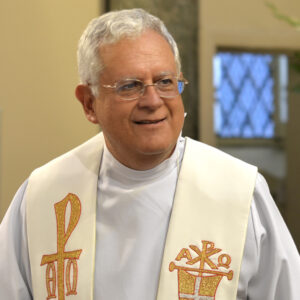
Fr. Paul Voisin, CR
Different cultures have different expectations when it comes to personal space. I came from an area of Canada heavily influenced by Germans. Before World War One the city of Kitchener was called Berlin, that is how German Waterloo County was and is. In many ways, hugs and kisses were often expressions of love, respect and affection reserved for special occasions. When I went to work in Bolivia part of the adjustment was to very different expectations and experiences to do with personal space. For instance, when I would visit a home for the first time it would be acceptable, as a ‘gringo’ (foreigner) to shake hands, but upon leaving the usual good bye was a kiss on the cheek for the women, and for the men (in one movement) a handshake/embrace/handshake.
I thought of personal space when I first read the gospel of this weekend (Matthew 15:21-28). The Canaanite woman invaded the personal space of Jesus. First of all, she called out to Him, drawing attention to herself and pressuring Jesus for a response. The disciples wanted Jesus to send her away. Jesus listened to her, and responded to her plea. Moved by her faith he responded to her, and her daughter was healed.
The exchange of words between the Canaanite woman and Jesus has been the subject of great debate and attention over the years. Some are taken aback by Jesus words, referring to “dogs”, as if it were disrespectful to the woman. However, the woman accepted the analogy but protested that “even the dogs eat the scraps that fall from the table of their masters”. Jesus came for the “lost sheep of the house of Israel”, not for the Canaanites, pagans who worshipped a multitude of gods. The analogy of Jesus signifies that He is concerned about those at the table – His fellow Jews – and not about those who circle around him but are not of the chosen people – the dogs and others not seated at the table.
The theme of inclusion continues in the other two readings. In the First Reading from the Book of the Prophet Isaiah (56:1, 6-7) God reveals that those “foreigners who join themselves to the Lord, ministering to him, loving the name of the Lord, and becoming his servants … (he) will bring to the holy mountain”. Doing what is right and just will unite them to God and His ways.
In the Second Reading from the Letter of St. Paul to the Romans (11:13-15, 29-32) St. Paul directs himself to the Gentiles – the non-Jews – as their “apostle”, encouraging them to follow Christ and be obedient to God. He has already scored many victories, so He delivers this message with confidence and courage.
As I reflected on the woman and Jesus, certain similarities came to mind that perhaps helped their communication, and the resolution of the woman’s plea. First, they are both in a foreign land in the region of Tyre and Sidon, Jesus from Galilee and she from Canaan. They are – in some way – in the same vulnerable situation away from their home. In that situation, they are both in need. A second similarity is that they are both living on behalf of others – the woman pleading for the health of her daughter, and Jesus pleading with the Jews to listen to Him and His words. They both have a mission outside of themselves, putting others first – the woman the love of a mother, and Jesus the love of the Anointed One, the Messiah.
This meeting of Jesus and the woman goes beyond them and their encounter. It serves as a reflection for us today. An important theme, for me, is the universality of God’s love, revealed by the healing of the Canaanite girl, possessed by an evil spirit. Both Isaiah and St. Paul speak eloquently of God’s benevolence and care, and how he reaches out to those people of good will who seek to do God’s will. In a world marked by ‘them’ and ‘us’ it is a challenge for us to reflect that universality of God’s love. Too easily in our society we judge others and distance ourselves from those who speak differently, look different from ourselves, and those we may think do not ‘belong’. The gospel points out that those who did ‘belong’, the Jews whom Jesus was speaking to and calling to renew the covenant with God, did not listen. But rather those who did not ‘belong’ – the non-believer, the foreigner, the tax collector, the prostitute, and the public sinners – were listening. Our love, inspired by God, is to also express and make real that universality of God’s love.
Jesus showed compassion toward the Canaanite woman. We are called to also show compassion. Like Jesus and the Canaanite woman we are also ‘strangers’ in this land, because our true home is in heaven. No matter where we came from or how we got here, we are all pilgrims in this life. We are all ‘on the way’, sharing this path together. Our shared journey of faith should reflect this unity we have as children of one Father. The love we share should reflect that we have one Lord, Jesus Christ. And the hope that binds us to one another is fostered by the Holy Spirit.
Another important application that challenges us is that, like Jesus and the Canaanite woman, they were both about others. A popular saying, reflective of our age, is “It is all about me!” This gospel calls us to be about and for others – advocating for them, loving them, and serving them. It is not enough to just have the intention, but to do something about it – to get our hands dirty and do and be for others. Pope Francis has spoke about the image of the Good Shepherd and how the shepherd must begin to smell like the sheep. If we truly believe in loving and serving others were need to be prepared to smell like the sheep around us – involving themselves in their joys and sorrows, in their struggles and victories. Neither Jesus nor the Canaanite woman were mere observers. Neither of them would have got anywhere with that attitude. They were willing to get involved, take a risk, and build up someone or something. If the Canaanite woman would not have invaded the personal space of Jesus, and encountered Him, her daughter would have remained bound by the evil spirit.
From these readings this weekend, let us open ourselves to God’s power and share more fully in his life, entering into each other’s personal space, and thus bringing life and healing to others.
Share This Post
More To Explore

28th Sunday in Ordinary Time – October 11, 2026
So many come to Mass without their hearts being clothed with the right spirit, with the proper wedding garment…
27th Sunday in Ordinary Time – October 4, 2026
The readings about vineyards made me think about the work that the people of Tanzania put into planting their staple crop of corn…