
Sunday Reflections
3rd Sunday of Easter – April 19, 2026
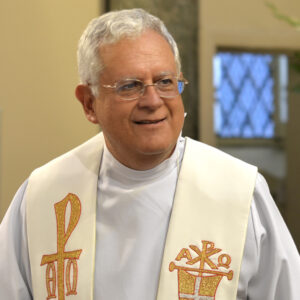
Reflection by:
Fr. Paul Voisin, CR
There is a story about an artist who was asked to design the door for a tabernacle. He divided it into four parts: the first was with the six water jars from the wedding feast of Cana, the second with the five loaves and two fish, the third with thirteen people seated around a table, and the fourth of three people at a table. He saw the first part from Cana as the preview of the Eucharist, the second part from Capernaum as the promise of the Eucharist, the third part from Jerusalem where it was instituted, and the fourth part from Emmaus where it was first celebrated.*
Our beautiful gospel today (my favourite) (Luke 24:13-35) speaks to us so beautifully about the Eucharist. The two disciples on the road to Emmaus are sad and confused. All the plans they had for Jesus ended with His death. Then, Jesus comes and walks with them and makes their hearts burn and their eyes be opened. Only after the fact did the two disciples realize that when this ‘mystery man’ spoke to them on the road their hearts were “burning” as they finally began to understand the story of Jesus. It was like the pieces of a puzzle coming together, and finally they understood the mysteries of His life, death and resurrection. Then they also realized that when this ‘mystery man’ broke the bread they recognized Him as Jesus, the Risen Lord.
In the First Reading, from the Acts of the Apostles (2:14, 22-33) Peter bears witness to this faith that the two disciples – and all the disciples of Jesus – began to experience after the resurrection. Their sorrow was turned to joy, and they went about proclaiming Jesus, crucified and risen.
In the Second Reading, from the First Letter of Peter (1:17-21), we are reminded that Jesus has saved us by His blood, and the sharing in His Body and Blood should transform us into believers whose lives reflect that reality. He tells us that we have been “ransomed” for a better life in Christ. We are not about “perishable things like silver and gold“, but about the things of God and of the kingdom.
The Eucharist was described by the Bishops at the Second Vatican Council as the “source and summit” of our Christian life. At the Eucharist we encounter Jesus Christ in a unique and personal way. Just as the food and drink that we have at home becomes a part of us, so too the Body and Blood of Christ that we receive in faith becomes a part of us, nourishing and strengthening us in faith, hope and love. As Catholics we believe that this bread and wine that is consecrated on this altar is no longer bread and wine, but becomes – through the power of God – the Body and Blood of Jesus. Jesus did not say “This represents my Body”, or “This is a symbol of my Blood”. It is what He says it is, and as we eat and drink it we become one with Him.
Our gospel shows us so beautifully the two Liturgies of our Eucharist – the Liturgy of the Word, and the Liturgy of the Eucharist. As Jesus shared with the two disciples all that the Hebrew Scriptures had revealed about Him their hearts “burned” with understanding and insight in how to live and respond to God’s grace. As we celebrate the Eucharist the Word of God – from the Old and New Testament – reveal to us who Jesus is, who our God is, and who we are. Then the pieces of our ‘puzzle’ will come together, and we will not only understand the revelation, but we will embrace it and live it. The Word of God is directed to each of us here and now. We cannot dodge the Word by convincing ourselves that it was written for another people at another time. He is speaking to us here and now – to our ears, minds, hearts and spirits.
When the two disciples saw this ‘mystery man’ break the bread they knew it was the Lord Jesus, but He vanished from their sight. When this bread is blessed, it becomes the Body of Christ, and when we break it and distribute it we are sharing in the life of God. The words of the Eucharistic prayer speak to us so beautifully of what we are celebrating, and the gift that God is giving us through his Son, Jesus, and by his sacrifice the gift of the Eucharist.
The two disciples, after they had recognized Jesus, got up from the table and went to tell the others what they had seen and heard. They had to bear witness to the others, to encourage them, so that they would know that He had risen, and that He was among them again. Of course, when they got there, others had also seen the Risen Lord and had given their testimony to the disciples. To me, this means that we too are being sent out to witness to others about our experience of the Eucharist. There will always be those who say “It’s always the same”, and “It is boring”. It is not the same! The readings we hear today, the Third Sunday of Easter of Year ‘A’, we have not heard since the Third Sunday of Easter of 2022, and will not hear them again until 2028. It is only boring if we are not engaged, realizing that God is speaking to us. Any conversation, lecture, class, or Mass can be boring if we are not involved, realizing that there is something in this for us.
We have the advantage to live in a time in history in which the Eucharist has not only been prophesied, and promised, but also instituted and celebrated. It is happening at this moment, and we are all a part of it, so that our hearts may “burn” and our eyes may be “opened” and our walk with Jesus will produce in us a life that reflects that union with Him, that love and mercy that is ours through Him, and the call to share His life with others.
*This introductory story is taken from Illustrated Sunday Homilies, Year A, Series II, by Mark Link, S.J. Tabor Publishing, Allen Texas. Page 35.
Share This Post
More To Explore

28th Sunday in Ordinary Time – October 11, 2026
So many come to Mass without their hearts being clothed with the right spirit, with the proper wedding garment…
27th Sunday in Ordinary Time – October 4, 2026
The readings about vineyards made me think about the work that the people of Tanzania put into planting their staple crop of corn…