
Sunday Reflections
28th Sunday in Ordinary Time – October 12, 2025
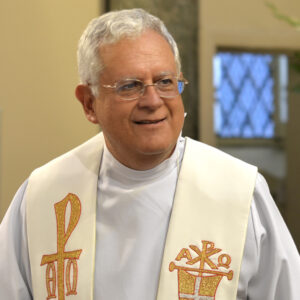
Reflection by:
Fr. Paul Voisin, CR
There is an odd phenomenon that not only people have spoken to me about, but that I have experienced in my own life. It really strikes me as odd, and very un-Christian. Perhaps you can relate to it, too. For instance, I do a favour for someone – let us say, I loan them money. The person is grateful and expresses it, as it really resolved a problem for them. However, after they have paid me back, instead of continuing in our normal friendship – not even expecting that expressions of gratitude will be ongoing – they distance themselves, stop associating with me, and even seem angry at me. Like I have done something wrong! I don’t understand it!
I thought of that because of the gospel (Luke 17: 11-19). We hear the famous healing of the ten lepers by Jesus. Jesus responds to their cries for help. After all, their lives with leprosy meant a complete separation from all their loved ones, and from any sort of work. This highly contagious disease, at that time and place, was like a slow death-sentence. So, the healing of the lepers was very significant, and a cause of great joy and relief for each of them. Yet, it was only one of them that had gratitude to Jesus – recognizing that his power was the source of the healing – and came back to express the gratitude. What is also significant in this gospel is that the man was a Samaritan, someone to be avoided by the Jews. Whereas the Jews worshipped God on the Mount in Jerusalem, the Samaritans had their own sanctuary, Mount Gerizim. They saw no need to go to Jerusalem, and this separated them from the dominant Jewish community. Remember the Scriptures about the Samaritan who helped the man beaten on the road between Jerusalem and Jericho, and also the encounter between Jesus and the Samaritan woman at the well? Both of these show the estrangement between Samaritans and Jews.
In the First Reading, from the Second Book of Kings (5:14-17) we see another healing of a leper, Naaman. Naaman was a pagan, who came to the prophet Elisha for healing. Although Elisha asked him to do something as simple as washing seven times in the River Jordan, much to Naaman’s surprise, he was cured. Then Naaman, filled with gratitude, proclaims that the God of Israel is the one true God, and he abandons his pagan gods to whom he offered sacrifices.
In our Second Reading, from the Second Letter of Saint Paul to Timothy (2:8-13), St. Paul reminds the early Christians, through Timothy, that they have been saved and made clean, and made whole in Jesus Christ. Even though Paul witnesses to his suffering, and recalls the times he was chained “like a criminal” for the sake of the Gospel, he still preaches the Good News. But Paul implies that there is a price: “if we have died with him we shall also live with him; … if we deny him he will deny us. If we are faithful he remains faithful”. Only if we are willing to ‘die’ to sin with Him will He live in us. If we are unfaithful, even to the extreme of denying Him, we will be denied. This new life in Christ should fill us with gratitude toward God.
The more I reflected on the readings, and the theme of gratitude, the more I realized we are experiencing a crisis in this Christian virtue in our time. It seems that we think it is a weakness to admit gratitude. It admits a vulnerability, a need, that we have had, and (thanks be to God) was responded to with generosity, compassion, and love. This ties in, I believe, with the very prevalent theme of entitlement, and the idea, “I don’t owe you thanks, because it is your duty. It is your responsibility. You owe me”.
William Arthur Ward was an American author and motivation speaker who was born almost a hundred years ago. He once said, “Feeling gratitude and not expressing it is like wrapping a present and not giving it”. The crisis today is that many people do not even “wrap the present“, let alone “give it“. Can you imagine buying a gift with care, wrapping it with care, and then not giving it away? Putting it in the closet or in the attic? The purpose for which it was intended is not being fulfilled. The sentiment of gratitude is being denied and avoided. This is the world in which some people live in today.
I remember, as a child, when it was Christmas or my birthday and I would open a present, my mother would ask, “What do you say?” Sometimes we need to be reminded to be grateful! Especially to be grateful to God, who is the source of all that we have and are. In our world that so vigorously applauds self- sufficiency and pride, it is difficult not to fall into the attitude that “I did this!” “I accomplished this!” Yes, we have used well our time, talents, imagination, and resources to accomplish something important, but too easily we forget God, who is the giver of all of these ‘tools’ to happiness and success.
In family life, as well, children can too easily take the attitude that “You are supposed to do that.” “It is your ‘job’!” and not express gratitude to parents. Likewise, parents can also at times forget to say “Please” and “Thank you!” when they ask their child to do something. At work and at school, all too often, as well, we can adopt the attitude that “That’s what you get paid for!” rather than acknowledge the efforts and contributions of all – employers and employees, teachers and students – to the common good.
The healing of the ten lepers not only reveals the mercy and power of God, but unfortunately the lack of gratitude in our human condition. We have the power to change that, to turn that tide and show our gratitude to God and others. Saying “Please” and “Thank you!” is a start, but the showing of gratitude – to God and others – means recognizing the contribution of others, whether it is love, or mentoring, or compassion, or instructing, or serving, or giving a helping hand, or doing something for us. Let us not identify with those nine lepers who rejoiced in their new found freedom, but forgot the source of that freedom, but let us return to the Lord and give Him thanks.
Share This Post
More To Explore

25th Sunday in Ordinary Time – September 20, 2026
Today’s readings call us to reflect on how we accept the ‘ways’ and ‘thoughts’ of the Lord, especially in relation to accepting His unconditional and generous love.

24th Sunday in Ordinary Time – September 13, 2026
Perhaps this coming week, we all can thank God for the mercy we have received and then, examine our relationships with those around us.