
Sunday Reflections
Thirty-third Sunday in Ordinary Time – November 16, 2025
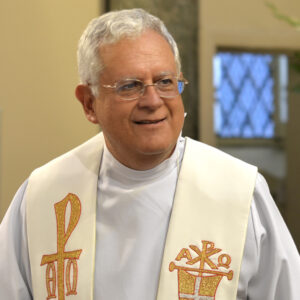
Reflection by:
Fr. Paul Voisin, CR
In 1947 the Bulletin of Atomic Scientists inaugurated a ‘doomsday clock’. The purpose of the doomsday clock is to show how things like the proliferation of nuclear weapons, the destruction of the environment, international political unrest are pushing our world closer and closer into the danger zone of global annihilation. At present the clock reads 11:57 p.m., with only three minutes to go to doomsday.
Reading the gospel of today (Luke 21:5-19) makes me think of that. As we come to the end of the liturgical year our readings become more and more the ‘gloom and doom’ theme. We cannot put our heads in the sand and think that the conditions which the ‘doomsday clock’ represents are not real. We only have to read or watch the news to determine that. On a human level this can lead to concern, fear, and despair. On a spiritual level Jesus tells us that God will “give us the wisdom” in speaking, and that “not a hair on our head will be destroyed“. He says that “by our perseverance we will secure our lives“. In the midst of such concern, fear, and despair Jesus gives us a message of hope, that we will overcome evil and destruction.
In our First Reading from the Book of the Prophet Malachi (3:19-20a) God’s messenger gives a message of hope, that for those who “fear the name of the Lord, there will arise the sun of justice with its healing rays”. They will be protected, and victorious over evil and the evildoers. Their faithfulness to God will see them through the turmoil and struggle.
In our Second Reading from the Second Letter of Saint Paul to the Thessalonians (3:7-12) St. Paul urges the people to imitate the holy life of those who faithfully follow the Lord Jesus. With the grace of God, and our dedication to our life in Christ we will overcome the obstacles to bearing witness to Jesus Christ.
The challenge for us, here and now, is how to live our lives in union with Jesus, to feel that strength and grace that comes from God, and to do the right thing always. Just as Malachi and Paul encouraged their listeners to trust in God, the Lord Jesus also tells us to trust in Him, and in the Father who sent Him. Although we may not feel that we are in the battle or the conditions in all three readings, this is a ‘wake-up call’ to all of us to intensify our life in Christ, to arm ourselves with the grace of God to overcome confusion, discouragement and helplessness.
As followers of Jesus we are called to be people of hope. The virtue most associated with the resurrection of Jesus is hope. I always like to think there is a difference between optimism and hope. Optimism is based on the good intentions of others. However, hope is based on our knowledge, belief and experience of the resurrection of Jesus – that God can do the improbable and the impossible. That is what God the Father did in raising Jesus from the dead – the improbable and the impossible. When the disciples went to the tomb on Easter morning, they never imagined that the body of Jesus would not be there. They had gone with oils and spices to treat His body, as was their custom after the death. But He was not there. He had risen! When we look at ourselves, our families, our communities, and our world we must do so with hope, a hope based on that power and grace of God to do the improbable and the impossible, if we are willing to cooperate with His grace and do His will.
As I reflected on the readings I also thought of the Apostolic Exhortations of Pope Francis. One of them is ‘Laudato Sí’, ‘Praised Be’. The basic question to which the Holy Father directs himself is, “What is happening to our common home?” It reminded me of the ‘doomsday clock’. Most people think of it primarily as an ecological thesis, but in it he directs himself to broader questions about the decline in the quality of human life – pollution, climate change, loss of water, loss of biodiversity, and global inequality. He looks at our world in a realistic way, and through the light of the gospel he gives us ways to improve that quality of life and recapture the design of the Creator. We need to rediscover how to use the gift of God, which is our world, as the giver of the gift intended.
Then Pope Francis wrote ‘Amoris Laetitia’, ‘On Love in the Family’. Here, too, he directs himself to the real world in relation to sexuality and marriage. Once again, the Holy Father calls us to rediscover the intention of the giver, God, in giving us these sacred gifts of our sexuality, marriage, and the family. In the news and entertainment world we are bombarded by messages that ‘the world’ is going in the opposite direction. What the Church believes and professes about these intimately human and spiritual realities is not respected by ‘the world’ today. Under the title of one’s ‘rights’ this abuse of God’s gifts have even become enshrined in legislation. To stand up for what we see as ‘right’ in the eyes of God brings criticism and condemnation upon us. It appears that the guiding principle for ‘the world’ today is to do what feels good, do what is easy and convenient, and reject the intention of the giver in the gifts of our sexuality, marriage and the family.
This year we are celebrating a Jubilee Year, with Pope Francis calling us to be Pilgrims of Hope. If God has inspired and sustained this hope in us, we are called to share it with others, in a world that often appears fearful and hopeless.
If we are people of hope – that God can do the improbable and the impossible – we face each day with the intention to be instruments of God’s will in the lives of our loved ones and of our world. Despite the challenges and difficulties we know that God is with us, and His grace is abundant. Our quality of life speaks volumes to ‘the world’ and we cannot underestimate the influence and power we have in the lives of others and in our world. Let us give that testimony with wisdom and courage.
Share This Post
More To Explore
Palm Sunday of the Lord’s Passion – March 29, 2026
Jesus is the suffering servant who undergoes much suffering and even death, but is raised up and exalted by God because of his continued trust in God.

5th Sunday of Lent – March 22, 2026
If Jesus raised a dead man, He can also help us transform our lives. Jesus says repeatedly “If you believe…”